Yongdzin Rinpoche’s Birth Anniversary – The meaning of the word ‘lama’
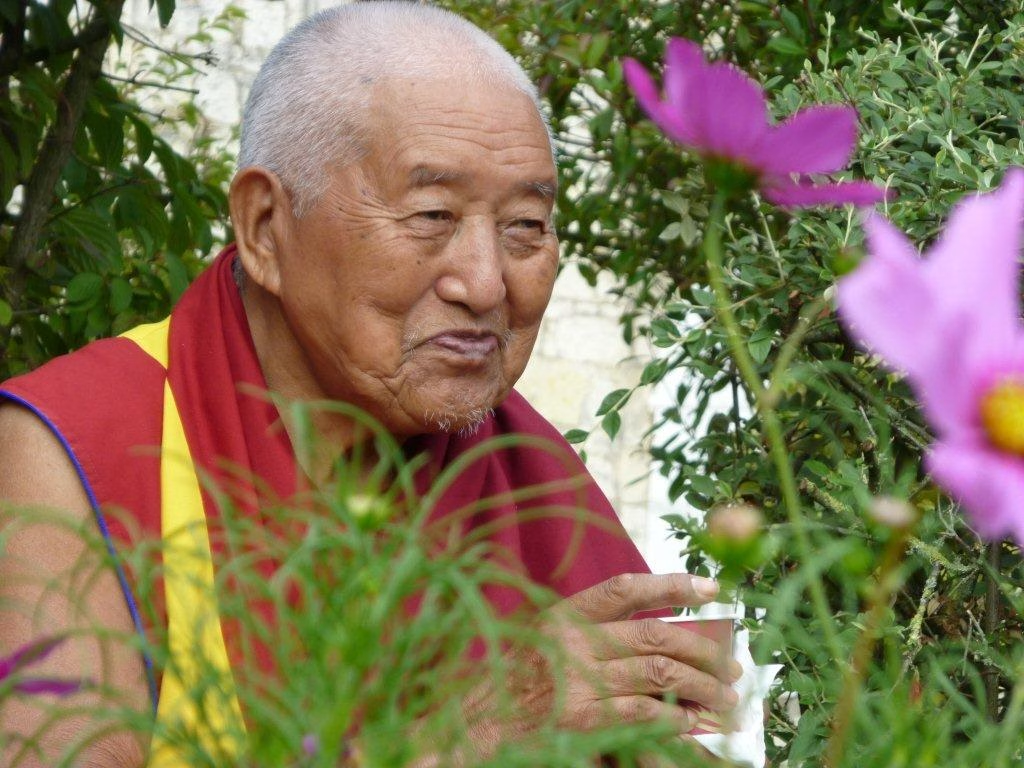
Today, on the 15th day in the 2nd month in the Shen system (15th day of the 1st month in the Horda system) we celebrate the birthday anniversary of one of the greatest lamas of the 20th-21st centuries, Yongdzin Lopön Tenzin Namdak Rinpoche, the Supreme Teacher of the Yungdrung Bön tradition. Yongdzin Rinpoche was an incredible scholar and practitioner endowed with immeasurable compassion and wisdom. He dedicated his life to the restoration, preservation and dissemination of Yungdrung Bön, saving it from serious damage during yet another persecution, the Cultural Revolution. Thanks to his unbendable deep devotion, profound knowledge of Tönpa Shenrab’s living tradition and unflinching perseverance, Yongdzin Rinpoche managed to preserve and revitalise Yungdrung Bön both in Tibet and beyond. Together with just a few learned lamas, who found themselves in exile, he re-stablished traditional education programs and founded monasteries and study centres where a new generation of both monastic and lay scholars and practitioners can flourish.
Truly the most kind and knowledgeable person, Yongdzin Lopön Tenzin Namdak Rinpoche profoundly influenced the spiritual development of all those fortunate enough to meet and receive teachings from him personally. Even those who did not meet him personally but came in contact with his teachings – his books, transcripts and videos – receive great blessings and a deeper understanding of Yungdrung Bön doctrines. Yongdzin Rinpoche’s legacy shall continue benefitting Bönpos for countless generations to come.
To celebrate this auspicious date, we have decided to publish a short excerpt from Rinpoche’s teachings on the meaning of the word ‘lama.’
The meaning of the word ‘lama’
I have to explain what ‘lama’ is, what this word means.
General meaning and etymology
Generally, ‘lama’[1] can mean two things: root lama,[2] and lineage lama.[3] Even Lord Buddha Tönpa Shenrab[4] is a lama. But as for the term itself, it is a Tibetan word combined from two words or syllables. The first, la,[5]in this case means ‘over’ or ‘higher;’ originally, la means to keep something very high, respectfully. And ma[6] is like mother; generally, ma means a person who has knowledge, general knowledge, but in particular, it refers to someone who has practised with compassion and loves all sentient beings like a mother loves her only child. The Tibetan word for mother is also ‘ma.’
So together la-ma means: ‘highly respected like a mother.’
Modern meaning
But nowadays, lama is very popular as a name and is no longer connected to the real, original high meaning. For example, there is a kind of clan or ethnic group in Nepal called Lama, and in this case, Lama is like a surname. So nowadays the title lama isn’t meaningful. It has become useless now, very popular.
Meaning of lama according to the text
But we have to go according to the text and keep that meaning. Whatever you practise, be it Sutra, Tantra or Dzogchen,[7] you can read the texts and teachings in your language and can get some idea from those texts, but actually, you cannot judge whether the idea or knowledge you have got is perfect and right, whether you have understood what the writer wished or intended or not. You cannot gauge this. When you are reading, you can understand something according to your own language and your own background or capacity, but such understanding depends on your own intention. The text doesn’t say whether your understanding is right or wrong. It can’t tell you that. You judge by yourself whether you have understood correctly or not.
Generally, Sutra, Tantra and Dzogchen – and especially our teachings – use specific terms to convey essential meanings which must be kept very, very strictly. Especially as regards Dzogchen; the View[8] must be kept perfectly. So yes, there is the text and some oral teachings, and you can study everything thoroughly and think you understand, but then you always have to follow the Master. That is your Lama.
And you have to check that the Master is a qualified one – it is not enough if he just speaks nicely and you can understand something. That is not enough. There are certain qualities which a Master needs. Each text has a very large section explaining this.
Checking your understanding with your lama
How can you be sure that you have understood correctly? How can you check whether whatever knowledge you have gained from listening to teachings or reading them is right or not? When you listen to teachings from a real Lama or Master, he will tell you whether what you have understood from the text is right or not. But that depends on the Master. In this case, the Master must be a qualified one – it is not enough if he can just explain something, because you are relying on him for this knowledge. If the master is not a qualified one then your work will be spoilt, no use.
The role of a lama
So first of all, you have to check whether the Master is a qualified one. The second thing is to know what you want to learn and listen to. There is no need to study everything, that would be too much – we have so many different teachings in our Yungdrung Bön tradition! So according to your own circumstances and intention, you listen, follow and try and practise the teachings that are suitable for you. In this case, you have to trust your Master. From your side, you have to respect your Master as Buddha because what your Master tells you is not just his own invention or something he has composed as teachings or a commentary; the Lama must follow the text exactly without making any mess, without adding anything, without missing anything – only following Buddha’s teaching. So in this case, you have to trust your own Master and on your side, you must think he is as Buddha. Don’t check whether he is Buddha or not; you don’t need to check anything because even if Buddha came directly to you, all he could do would be to give teachings like your Master does. Buddha can’t give you anything special, he can only give you advice as to what you can do to purify sufferings and miseries. In this case, the Buddha’s message is explained by your own direct Master without any addition or omission. Therefore, you have to respect your Master highly.
Finding a qualified lama
It is difficult to know whether a lama is qualified or not; it is not easy to realise this. Generally, don’t rush to follow anyone. It is better to have time to check. The best thing is to read something which you mainly intend to practise – whatever tradition or subject you want to practise seriously. Then according to this text, ask yourself who is able to teach this properly and clearly? That is one thing.
Secondly, the text says that one way to check a lama is to use the same method as you would to check any kind of bush. Usually, if the roots of a plant are poisonous then the leaves, flowers and everything will be poison, too. If the root is medicine, then the trunk, leaves, flowers and everything is medicine. That is an example. It is similar. If you are wondering whether someone is going to be your own Master or not, you can take time to look and check whatever he is doing, saying and thinking; you can have time to check. If he is similar to a ordinary being, an ordinary public person, nothing special, then he is not a qualified man. But if he is clearly able to tell you what you want to learn and can correct you, then that person is suitable to be your own Master.
You should check these kinds of things. Even in the text it says that it is rather difficult to find a qualified master in these modern times; a perfectly qualified one is very rare, difficult to find. But nevertheless, you should find someone who is at least able to explain clearly the essential things which you particularly want to learn; that is a suitable Master for you.
That is the brief summary on how to find a qualified master.
Three groups of lamas
The Lamas are divided into three groups.
1. Lineage lamas of Sutra
First of all, there are the Lineage Masters for Sutra. Here, Sutra means Vinaya.[9] This lineage goes back to the source, to Buddha in the form of a monk,[10] the form of Tönpa Shenrab, Tritsug Gyalwa.[11] This is Nirmanakaya[12] form, human form. But Buddha Tönpa Sherab manifests as Sambhogakaya[13] form, and Dharmakaya[14] form, too – three different forms. All the Vinaya Lineage Masters and teachings go back to the Vinaya form of Buddha. That is one group, and these Lamas are all called the External Lineage Masters. ‘External’ here refers to Sutra, so these are the Sutra Lineage Masters.
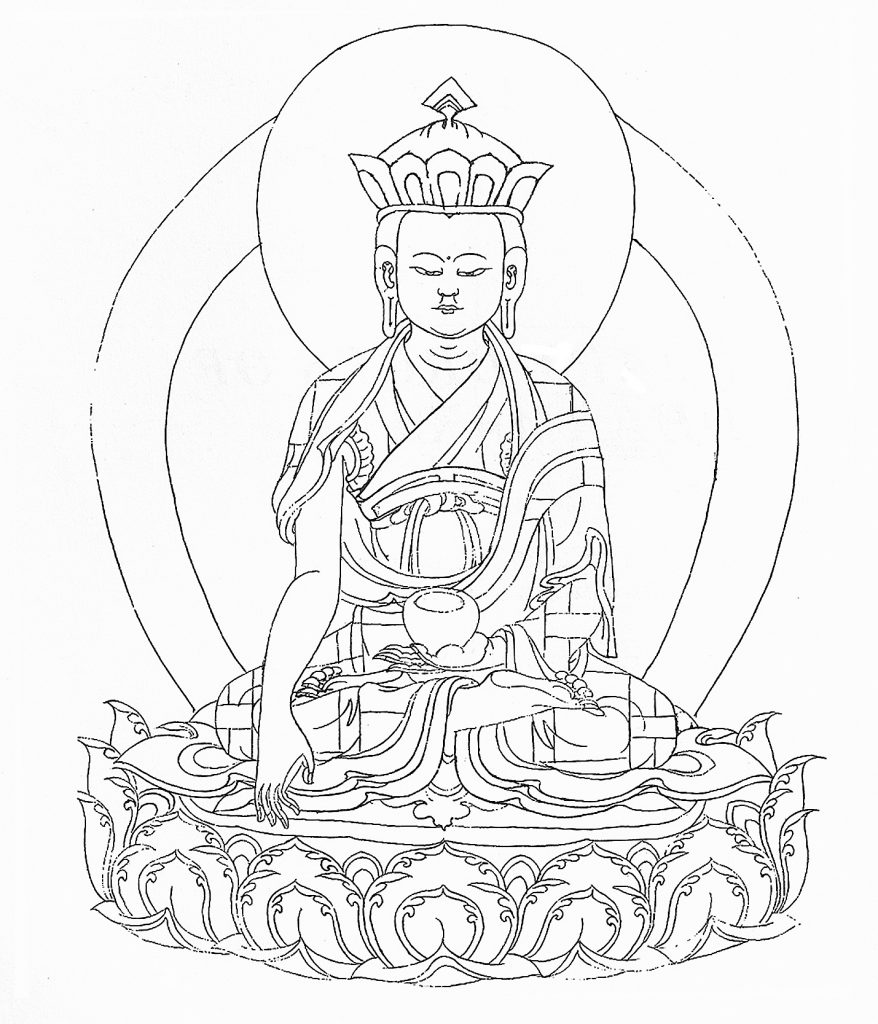
Line drawing by Tsering Yangphel, Yongdzin Rinpoche’s cousin. Image courtesy of Yongdzin Rinpoche.
2. Lineage lamas of Tantra
These lineages go back to the Sambhogakaya form, which is as Shenhla Wökar. Shenhla Wökar[15] is also a form of Tönpa Shenrab, the same thing, the same person, but showing the three different forms for Sutra, Tantra and Dzogchen. So, this second group of Lineage Lamas traces back to Shenhla Wökar, the Sambhogakaya form. That is the source of the Inner Lineage of Tantra.
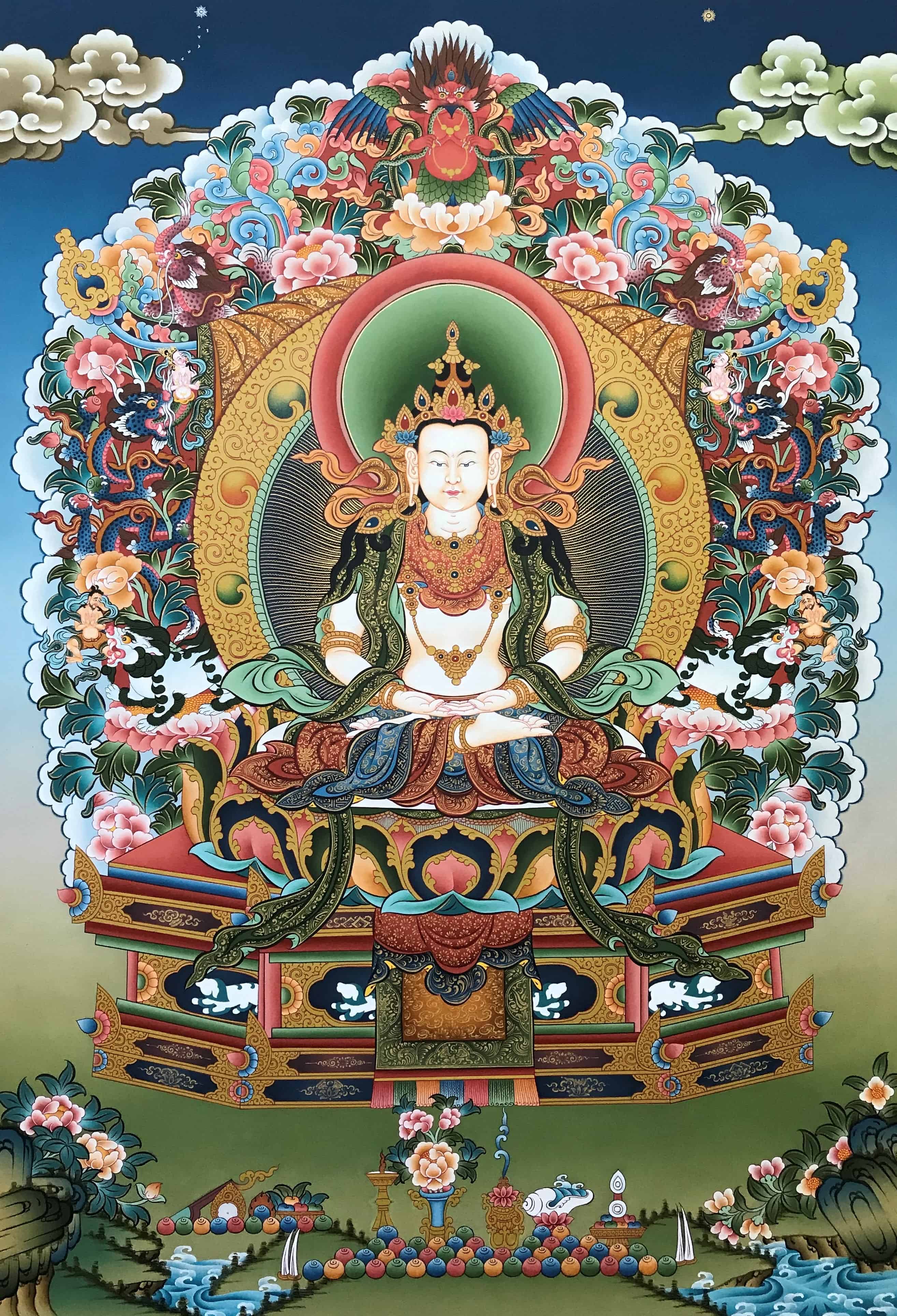
Shenhla Wökar. Image courtesy of Drubdra Khenpo Tsultrim Tenzin.
3. Lineage lamas of Dzogchen
The third group is the Secret Lineage Masters of Dzogchen. They go back to Dharmakaya. One after the other, they trace back to the Dharmakaya form of Tönpa Shenrab, Kuntu Zangpo.[16]
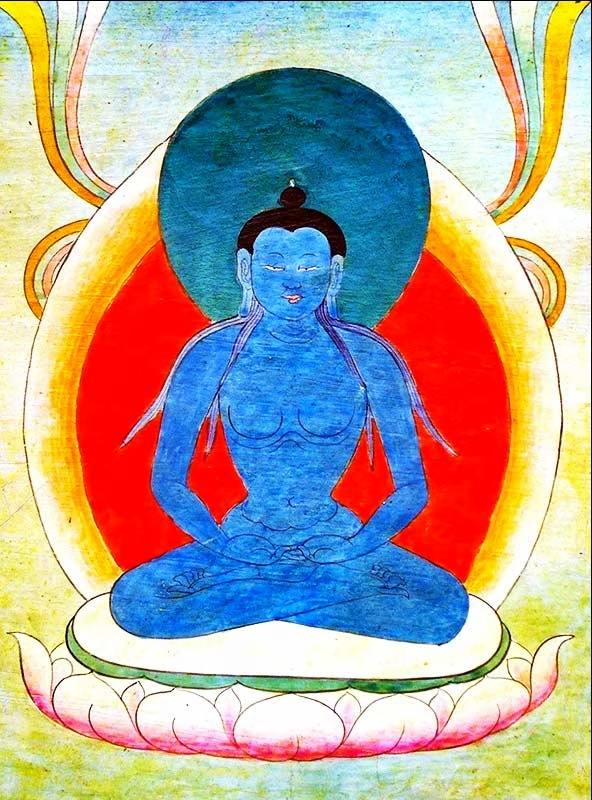
Kuntu Zangpo from Zhang Zhung Nyengyu tsakali set. Courtesy of Yongdzin Rinpoche. First published in Namdak, Yongdzin Lopön Tenzin, transc. & ed. Ermakova, C. & Ermakov, D. Masters of the Zhang Zhung Nyengyud: Pith Instructions from the Experiential Transmission of Bönpo Dzogchen, (New Delhi: Heritage Publishers, 2010), p.46.
One person, three lineages: Nyamme Sherab Gyaltsen[17]
All the real Masters are practitioners, and they have full knowledge of their texts – Sutra, Tantra or Dzogchen. It is not necessary for one person to keep all the three lineages, like we do in our lineage following the example of Nyamme Sherab Gyaltsen. Nyamme Sherab Gyaltsen was a very important figure in medieval times, in the fourteenth century, because he received and collected all three lineages and they all came together in his lineage. Nyamme Sherab Gyaltsen founded Menri Monastery[18] in Tibet in 1415 and his lineage is very important for us because all the abbots of Menri must keep all three lineages together. That is an important thing.
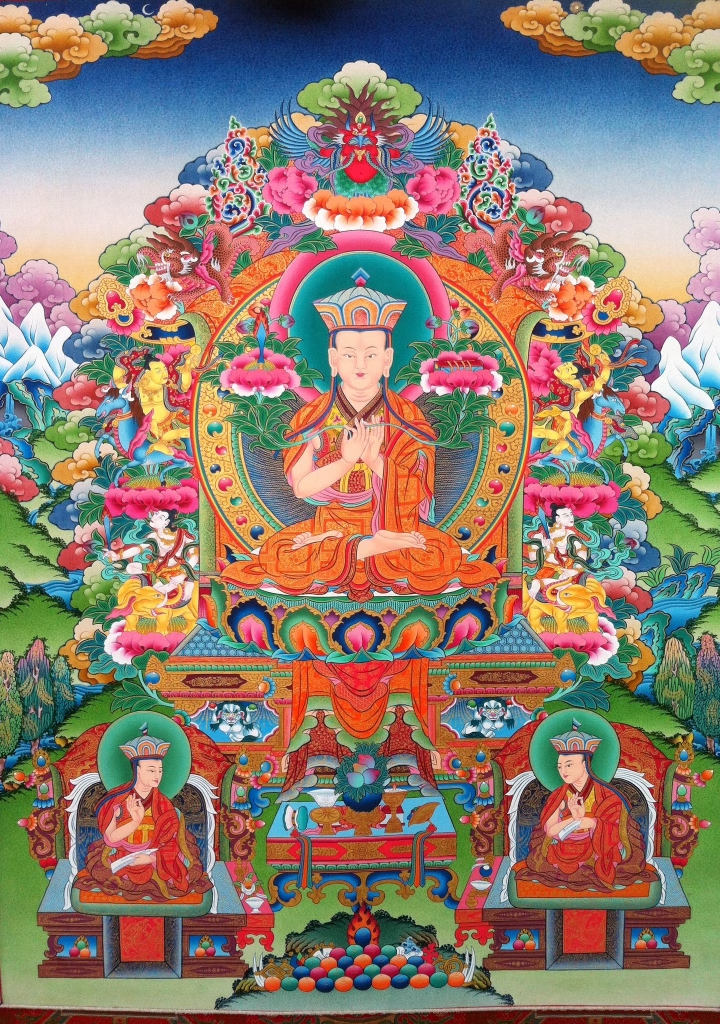
Nyamme Sherab Gyaltsen. Public domain image.
Sometimes there is criticism. For example, as I have just explained, Nyamme Sherab Gyaltsen collected the three lineages and put them together, and after him, all Bönpo monks keep the three lineages of Sutra, Tantra and Dzogchen, so sometimes people wonder: surely practitioners and lineage masters of Tantra must be secular people? They are not allowed to be monks. Some people make this criticism, and this is not only something which happens in modern times – there were so many contradictions and criticism in early times, too.
However, Nyamme Sherab Gyaltsen replied that Tantra is mainly the antidote which purifies all obscurations, sufferings, defilements and miseries. How they are purified depends on the method. There are four classes of Tantra and each of them explains how that method works, how it purifies obscurations, defilements, miseries, suffering, ignorance, and the Five Poisonous Consciousnesses.[19] Each of them is able to purify these, but in fact this purification only comes about through inner spiritual work, not just by some visible aspects such as rituals, body positions and movements or some material implements which we often associate with Tantra. To support this argument, Nyamme Sherab Gyaltsen quoted from the original texts and commented on them clearly, thus proving that it is not only lay people who can practise Tantra and keep the Tantric lineage. After this, then, in our tradition, one person can keep all three lineages. Not everybody has to, of course, because there are still different lineages and different people, but this is one way.
Re-edited excerpt from Namdak, Yongdzin Lopön Tenzin: Nine Ways of Bön; A Compilation of teachings in France, Volume II, GENYEN THEGPA Trnscr. & ed. Carol Ermakova and Dmitry Ermakov (Blou: Shenten Dargye Ling, 2008), pp. 110-116.
[1] Tib. bla ma / བླ་མ།
[2] Tib. rtsa ba’i bla ma / རྩ་བའི་བླ་མ།
[3] Tib. brgyud pa’i bla ma / བརྒྱུད་པའི་བླ་མ།
[4] Tib. Ston pa gshen rab / སྟོན་པ་གཤེན་རབ།
[5] Tib. bla. La is a very complex Bönpo concept with many layers not all of which are understood in later Tibetan Buddhism which adapted this native Bönpo concept to the teachings of Indian Buddhism. For more information see Dmitry Ermakov, Bө and Bön, pp. 519-523.
[6] Tib. ma.
[7] Tib. mdo sngags sems gsum / མདོ་སྔགས་སེམས་གསུམ།
[8] Tib. lta ba / ལྟ་བ།
[9] Tib. gdul ba / གདུལ་བ།
[10] Tib. drang srong / དྲང་སྲོང་།
[11] Tib. Khri gtsug rgyal ba / ཁྲི་གཙུག་རྒྱལ་བ།
[12] Tib. sprul sku / སྤྲུལ་སྐུ།
[13] Tib. rdzogs sku / རྫོགས་སྐུ།
[14] Tib. bon sku / བོན་སྐུ།
[15] Tib. Gshen lha ‘od dkar / གཤེན་ལྷ་འོད་དཀར།
[16] Tib. Kun tu bzang po / ཀུན་ཏུ་བཟང་པོ།
[17] Tib. Mnyam med Shes rab rgyal mtshan / མཉམ་མེད་ཤེས་རབ་རྒྱལ་མཚན། (1356-1415).
[18] Tib. Bkra shis sman ri / བཀྲ་ཤིས་སྨན་རི།
[19] Tib. dug lnga / དུག་ལྔ།
Cover image: Yongdzin Rinpoche in Shenten 2010. Photo by Carol Ermakova.
3 Responses
Thanks , so clear!
thank you, very succinct, all the important and relevant points in one brief teaching.
Thank you, Andy.