Shenhla Wökar and the Six Devourers
This explanation is based on teachings given by Drubdra Khenpo Tsultrim Tenzin during a retreat on Athri held in Calabria, Italy, September 2025.
Transcribed and edited by Carol Ermakova & Dmitry Ermakov.
Nine Manners of Purity
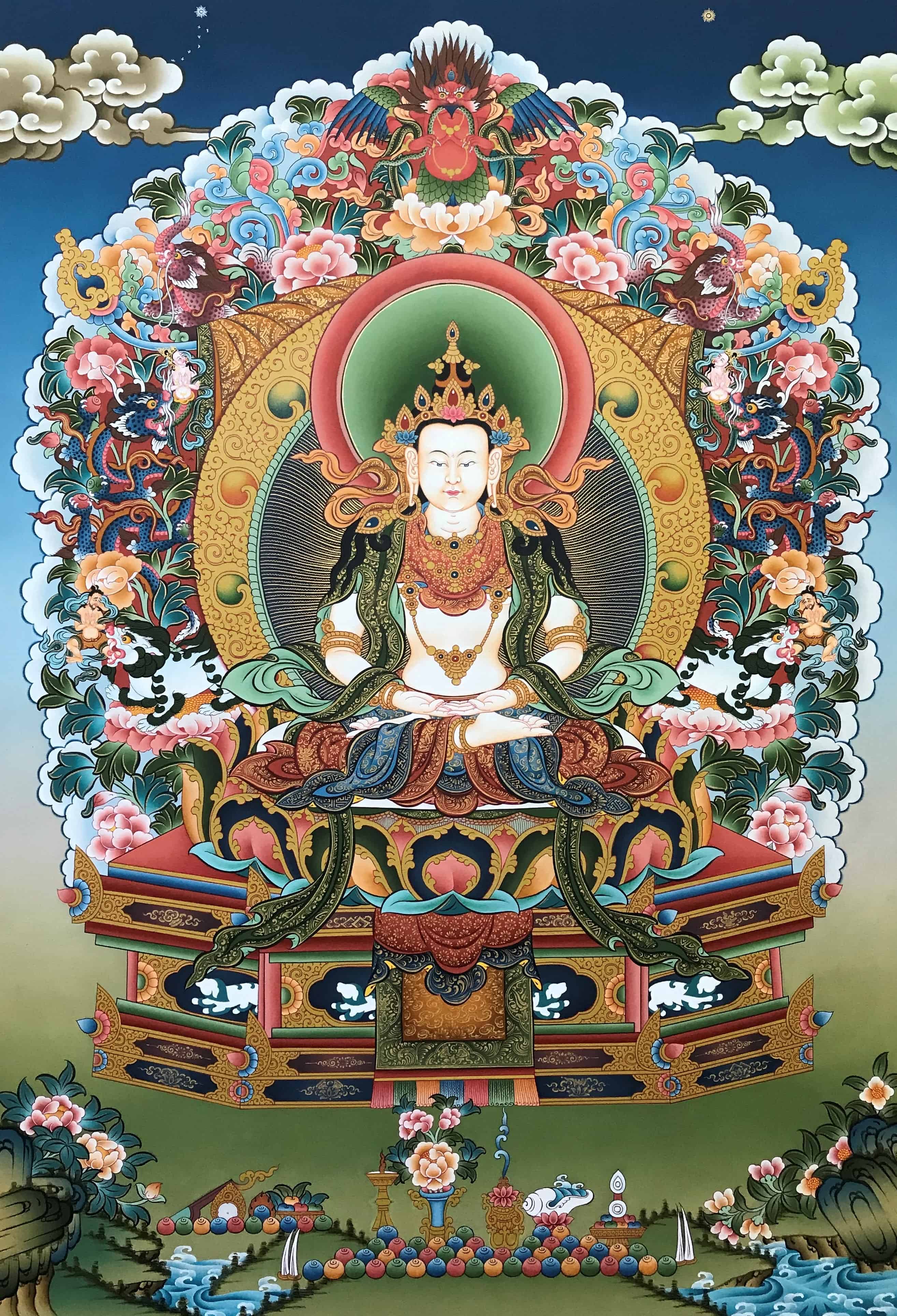
Shenhla Wökar[1] (see cover image above) is a peaceful manifestation, and like other emanations such as Jamma,[2] the features of his body, decorations and so on all hold special meaning. He displays the Nine Manners of Purity[3] and is adorned with the Thirteen Adornments of a peaceful sambhogakaya.[4]
His body is:
1. youthful
2. bright
3. luminous
4. with a clear lustre.
His manner is:
5. peaceful;
6. & 7. his limbs and fingers are supple and graceful.
He is:
8. beautifully graceful
9. blazing with splendour.
Thirteen Adornments of a Peaceful Sambhogakaya
1. Crown
2. Earrings
3. Short necklace
4. Medium necklace
5. Long necklace
6. Bracelets
7. Armlets
8. Anklets
9. Shawl
10. Lower garment
11. An umbrella above
12. A back- and headrest behind the throne
13. The throne.
He sits on a throne supported by snow lions, which represents the subjugation and purification of anger.
There is another very important detail which is often overlooked.
Behind him, depicted on the back of the throne, are the Six Devourers.[5] These are fierce animal-like creatures that devour all obstacles, demons and poisonous emotions.
There is an interesting story behind this.
The Story
Once upon a time, many years ago, there lived a great Prince called Gya Kongtse Trülgyi Gyalpo.[8] He ruled over a great kingdom and lived in China, to the South of Tibet, near a large lake, Tha Gyamtso,[9] which was so vast that it appeared as endless as the sea. Kongtse was a devout follower of Buddha Tönpa Shenrab Miwoche,[10] and from him he learned the science of astrology. Fascinated by this subject, he vowed to introduce and develop it in China. To this end, and to support the study of other Yungdrung Bön[11] sciences, Kongtse decided to build a library. Being a rich and royal man, he wanted his library to be unlike any other, a special edifice worthy of a true prince.
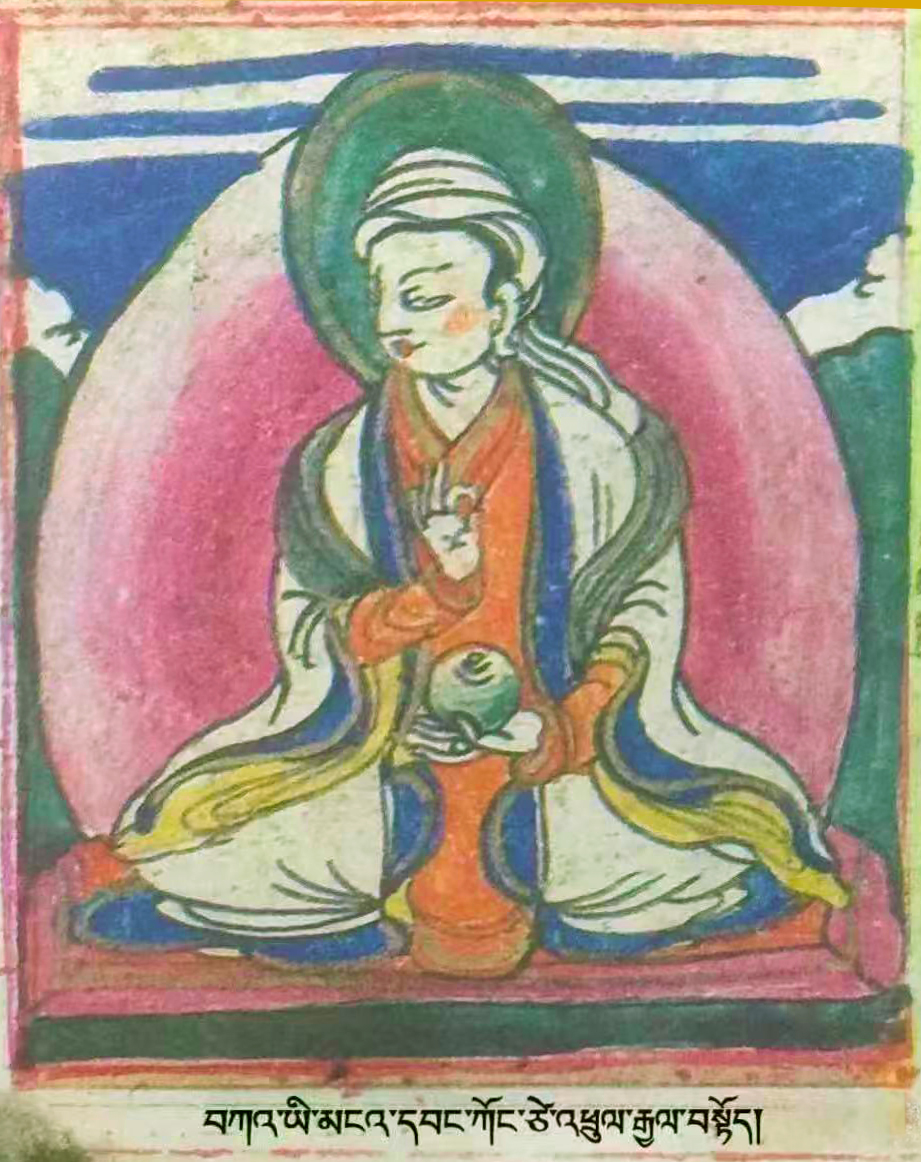
Gya Kongtse Trülgyi Gyalpo. Tsakali. Image courtesy of Drubdra Khenpo Tsultrim Tenzin.
Kongtse realised that this project would take several years, and vowed to work on it in secret. Nevertheless, he confided in his mother, saying:
“Mother, I am going away for some time. I am going to build a wondrous library to house the precious texts of Yungdrung Bön. I may be absent for several years, but please, do not tell anyone where I am or what I am doing. This library should be kept secret.”
“Your kingdom is so vast, where will you build it?” asked his mother.
“I do not know yet, Mother,” replied her son. “I will travel throughout my realm until I find the perfect spot. Do not look for me.”
And so, without asking his father’s permission, and telling neither his wife nor his children, the Prince left his family and his royal palace to set off in search of the special site for his magnificent library.
Soon his family began to worry about the missing Prince. They searched high and low for him, but to no avail. His mother, however, remained calm and serene, apparently unperturbed by her son’s sudden disappearance.
After some time, the Prince’s father became suspicious; he saw that his wife was not worried, and thought how strange it was that the mother was not concerned about her missing son. He decided that she must know something but was keeping it secret from the rest of the family. So one day he asked her:
“Why are you so calm, my dear? Our son has been missing for several months now, yet you remain calm and unperturbed. I think you know something. You must tell me!”
“No, no, my dear, I have no secrets from you!” his wife countered him. “I know nothing about our son’s whereabouts or what he is doing.”
But her husband did not believe her. Finally, worn down by his questioning, the Prince’s mother confided in her husband, telling him that although she did not know precisely where their son was, she did know that he was safe and had left the palace on a secret mission to build a magnificent library to house precious religious texts of Yungdrung Bön. Relieved, the Prince’s father agreed to keep his son’s secret.
And so several years passed. The Prince’s children grew up, and his wife continued to search for him, while his parents lived happily without showing any concern.
The Prince, meanwhile, was practising tantra,[12] and summoned 100 demons. His practice was so strong that his powers caused these demons great pain, as though their very hearts were burning. In agony, the demons begged the Prince for mercy, promising to obey him if he let them live.
“Very well,” said the Prince, “but you must help me on one very important mission.” And he told them about the library.
“I am looking for a very special place, because this library must be unique, to outshine all others.”
“We know such a place!” exclaimed the demons, and they told the Prince about a wondrous lake. “If you build the library in the centre of this lake, it will be glorious and protected! We will help you, but on one condition: nobody must know, and nobody can see us.”
So the Prince agreed.
He had already designed his library. It should be built in the shape of a yungdrung[13] and rise majestically from the pure waters of the lake.
The 100 demons emanated a further 300 demons, and 100 scurried off in each of the four directions to begin their work. The Prince remained in the centre, overseeing the construction as the foundations took shape, resting on the lakebed deep beneath the surface.
After toiling night and day for many months, the demons’ work bore fruit, and the mighty edifice was almost ready to rise triumphant into the air.
Back home, however, the Prince’s wife was beside herself with worry. Her husband had been gone so long! He had simply disappeared, without a word to her! Her children, too, missed their father, yearning for him and wondering why he had abandoned them. She had noticed, of course, that her mother-in-law seemed untroubled by her son’s absence, and became increasingly convinced that she must know something about her missing husband’s whereabouts. So one day, she confronted her.
“Where is my husband?” she demanded. “Why has he abandoned us? You are so unconcerned! I am sure you know something! But I am desperate, beside myself with worry, and my children are upset, too. Please, tell me what you know!”
“I don’t know anything, my dear…” her mother-in-law began, but the young woman interrupted her.
“Of course you know something! No mother could remain so calm when her son has been gone so long! Enough of your stories – if you don’t tell me the truth, I will kill myself!”
And so, reluctantly, the Prince’s mother told her about her son’s secret mission. Her in-laws told her not to fret, assuring her that her husband would be back safe and sound in a few years.
“No!” cried the young woman. “I am his wife! There should be no secrets between us. And anyway, I can help him.” She became very angry that her husband had kept something so important from her, and her children grew indignant, too. Vexed, they took some servants with them and set off together to search for the Prince.
After some time, the eldest son noticed some strange commotion far away in the distance. He went to look closer and gasped in horror. There, in the midst of a vast swirling sea, he saw a horde of strange demons, and in the middle was a man who looked a little like his own father. Afraid, the boy rushed back to his mother.
“I saw a lot of strange things, Mother! Many ghosts or spirits… They weren’t human… But in the middle was a man who looked a bit like Papa…”
“That is most certainly your father!” cried his mother. “I know your father has magical powers, he has magical mantras. For sure this man is your father! Let’s go!”
And so the family hurried over to join their father.
But when the demons saw humans approaching, they flew into a rage.
“You promised to keep this secret!” they shouted at the Prince. “You have broken your word,” they yelled. Cursing him and screaming, they disappeared in a flash. Not one remained.
The chief of the demons, Chenhla Miggu,[14] was a fierce-looking creature with three heads and six arms. Brandishing mighty weapons in each of his six hands, he rode a nine-headed boar. Now he was furious with the Prince. In a rage, he caused a mighty earthquake that shook the whole earth. The waters of the lake swirled violently, and the Prince’s precious library collapsed in ruins.
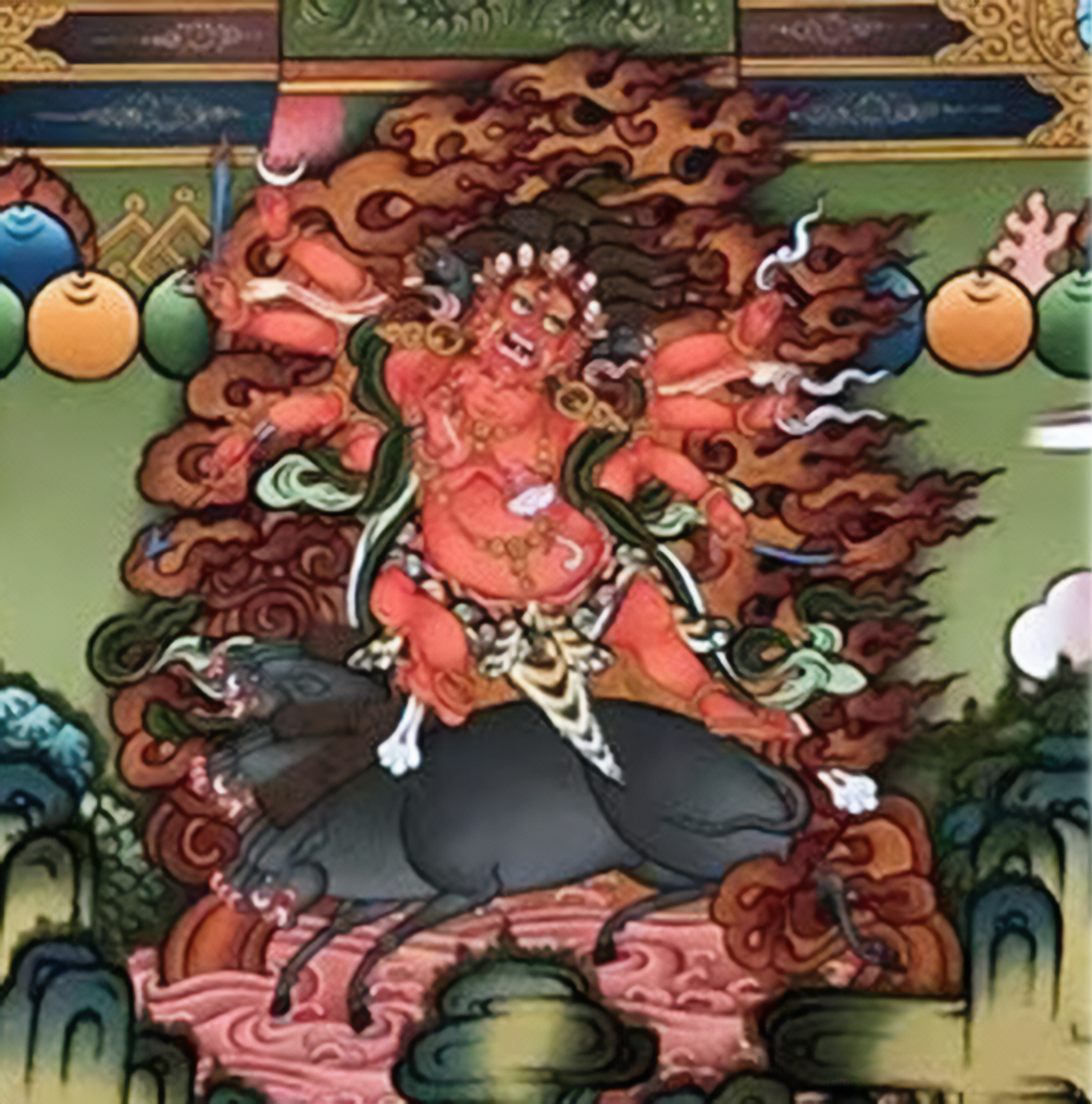
Chenhla Miggu. Fragment from a thankga of Nampar Gyalwa by Geshe Mönlam Wanggyal.
Now it was the Prince who was distraught. Instead of greeting his family, he scolded them.
“Look what you have done!” he yelled. “Now everything is destroyed! I will never be able to rebuild my library!”
In despair, he prayed fervently to Buddha Tönpa Shenrab for help. His heart was full of sorrow, and his devotion overflowed.
Seeing the Prince’s plight, Tönpa Shenrab appeared before him, taking the form of Nampar Gyalwa.[15]
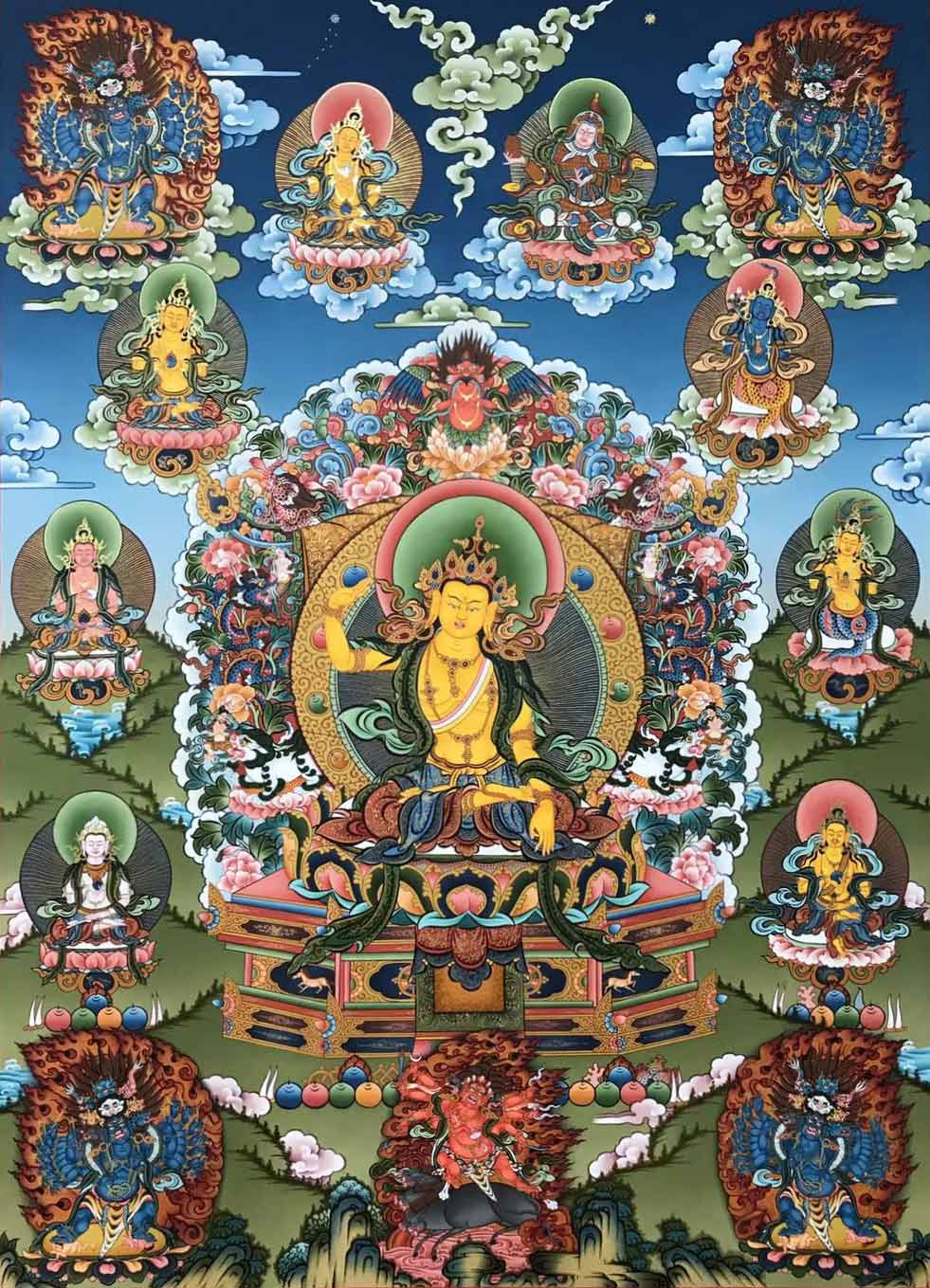
Nampar Gyalwa. Thangka by Geshe Mönlam Wanggyal. Courtesy of the painter.
Nampar Gyalwa was seated on a throne supported by horses. Behind him were two lions devouring brahmins, symbolising protection from malevolent brahmins.[16] Above his head were two mighty garudas devouring chusrin-crocodiles, symbolising protection from malevolent demons, and behind his throne were two roaring dragons devouring nagas, symbolising protection from malevolent nagas with the upper part of their bodies as a human and the lower part as a fish or snake.
Seeing these ferocious creatures devouring so many beings, the demons were very much afraid of being gobbled up by them, too. But there was nowhere for them to go. Unable to escape, they cowered before Nampar Gyalwa.
“I have many ravenous garudas, lions, and dragons under my command,” he told them. “So many thousands! They can easily devour and destroy every single one of you! Therefore, you must pledge to help the Prince, otherwise you will all be eaten up.”
And so all the demons promised to help the Prince, and soon the library rose out of the centre of the lake, more marvellous and majestic than ever could be imagined.
This is the story of the Six Great Devourers.
Thus, every aspect in the iconography of Shenhla Wökar and other peaceful yidams of Yungdrung Bön such as the Four Chief Buddhas:[17] Jamma, Wisdom Goddess of Compassion and Loving-Kindness[18], Sangpo Bumthri,[19] and Tönpa Shenrab Miwo, are steeped in symbology. The Six Great Devourers we see around their thrones are not just ornaments; they are powerful creatures that protect us from all manner of demons.
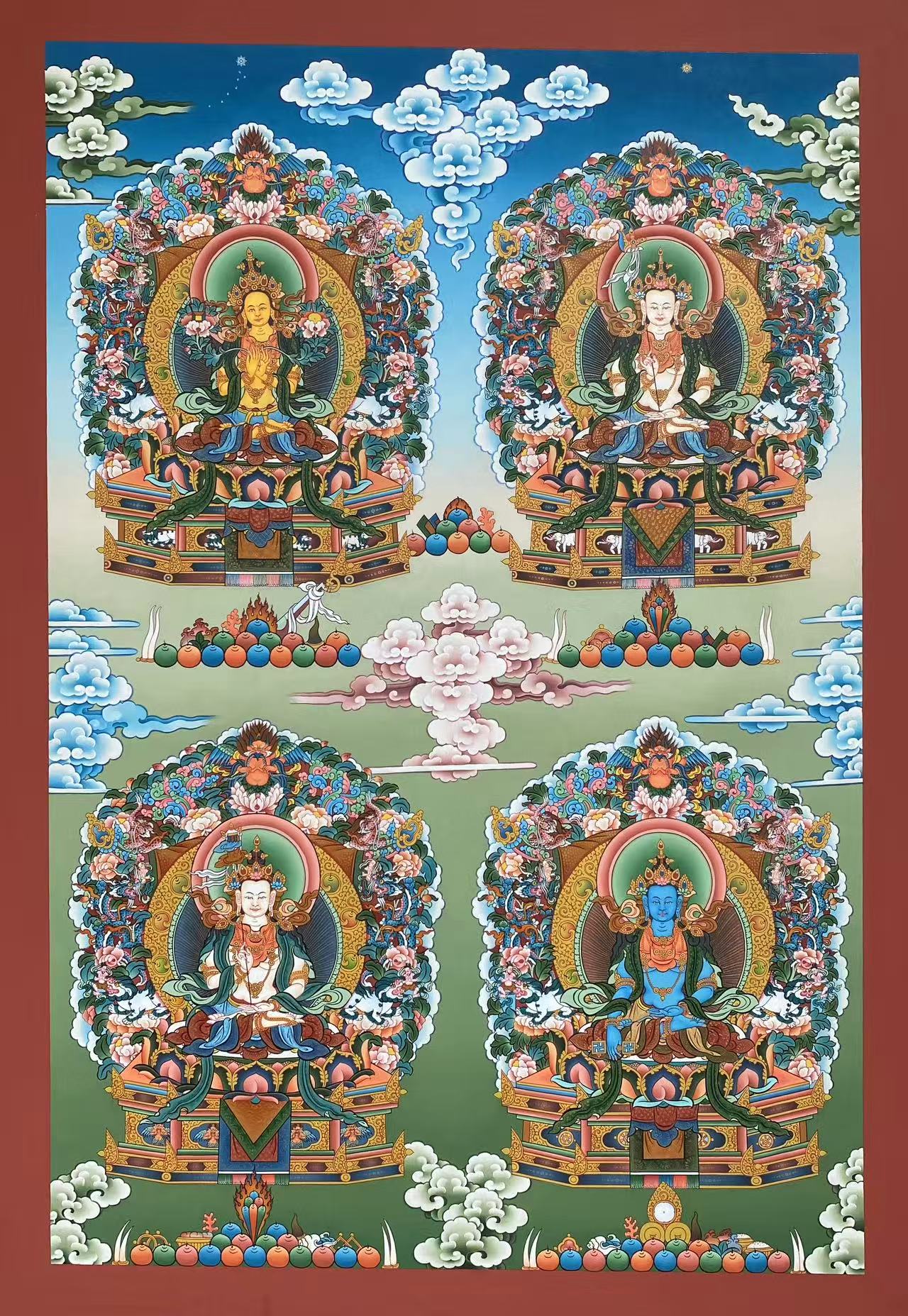
Four Chief Buddhas. Thangka image courtesy of Drubdra Khenpo Tsultrim Tenzin.
[1] Tib. Gshen lha ‘od dkar / གཤེན་ལྷ་འོད་དཀར། Shenhla Wökar thangka cover image courtesy of Drubdra Khenpo Tsultrim Tenzin.
[2] Tib. Byams ma / བྱམས་མ།
[3] Tib. tshangs pa’i thsul dgu ni: 1. sku gzhon pa, 2. mdangs gsal ba, 3. ‘od ‘char ba 4. tshul zhi ba, 5. yan lag mnyes pa 6. nying lag lcug pa, 7. ‘khril bag chags pa, 8. mdzes shing ldem pa, 9. Gzi byin rab tu ‘bar ba / ཚངས་པའི་ཚུལ་དགུ་ནི། ༡༽ སྐུ་གཞོན་པ་ ༢༽ མདངས་གསལ་བ་ ༣༽ འོད་འཚེར་བ་ ༤༽ ཚུལ་ཞི་བ་ ༥༽ ཡན་ལག་མཉེས་པ་ ༦༽ ཉིང་ལག་ལྕུག་པ་ ༧ ༽ འཁྲིལ་བག་ཆགས་པ་ ༨༽ མཛེས་ཤིང་ལྡེམ་པ་ ༩༽ གཟི་བྱིན་རབ་ཏུ་འབར་བ།
[4] Tib. zhi tgyan bcu gsum ni: 1. dbu rgayn, 2. snyan cha, 3. mgul chu, 4. do shal, 5. se mo do, 6. dpung rgyan, 7. phyag gdub, 8. zhab gdub, 9. gdan khri, 10. stod g.yog, 11. smad sham, 12. rgyab yol, 13. Dbu gdugs / ཞི་རྒྱན་བཅུ་གསུམ་ནི། ༡༽དབུ་རྒྱན་ ༢༽སྙན་ཆ་ ༣༽མགུལ་ཆུ་ ༤༽དོ་ཤལ་ ༥༽སེ་མོ་དོ་ ༦༽དཔུང་རྒྱན་ ༧༽ཕྱག་གདུབ་༨༽ཞབས་གདུབ་ ༩༽གདན་ཁྲི་ ༡༠༽སྟོད་གཡོག་ ༡༡༽སྨད་ཤམ་ ༡༢༽རྒྱབ་ཡོལ་ ༡༣༽དབུ་གདུགས།
[5] Tib. za drug / ཟ་དྲུག
[6] Tib. khyung / ཁྱུང་།
[7] Tib. chu srin / ཆུ་སྲིན། NB. Only one of the two garudas is visible. The second is under the throne, so it is not portrayed on thangkas, while the upper garuda is in the centre, above the throne. The two chusrins they are devouring, however, are generally depicted just under the top garuda to left and right of the throne; in this way, the composition of the thangkas is balanced.
[8] Tib. Rgya Kong tse ‘Phrul gyi rgyal po / རྒྱ་ཀོང་ཙེ་འཕྲུལ་གྱི་རྒྱལ་པོ།
[9] Tib. Mtha’ rgya mtsho / མཐའ་རྒྱ་མཚོ།
[10] Tib. Ston pa Gshen rab mi bo che / སྟོན་པ་གཤེན་རབ་མི་བོ་ཆེ།
[11] Tib. g.yung drung bon / གཡུང་དྲུང་བོན།
[12] Tib. rgyud, sngags / རྒྱུད། སྔགས།
[13] Tib. g.yung drung / གཡུང་དྲུང་། – Bönpo swastika which turns to the right, Tib. yas skor / ཡས་སྐོར།, i.e. counterclockwise.
[14] Tib. Gcan lha mig dgu / གཅན་ལྷ་མིག་དགུ།
[15] Tib. Rnam par rgyal ba / རྣམ་པར་རྒྱལ་བ། – All-Victorious.
[16] Tib. bram ze / བྲམ་ཟེ། These are not real brahmins but evil spirits who taken brahmin form.
[17] Tib. Bder gshegs gtso bzhi / བདེར་གཤེགས་གཙོ་བཞི།
[18] Tib. Shes rab ‘byams ma / ཤེས་རབ་འབྱམས་མ།
[19] Tib. Sangs po ‘bum khri / སངས་པོ་འབུམ་ཁྲི།